Most practitioners have a rough sense of how much time they spend on admin. And sometimes that estimate can be a little optimistic.
What this is: A structured exercise and worksheet that helps you map where your non-clinical time actually goes, and whether it’s working for you.
What you’ll have when you’re done: A clear picture of your top three time and energy drains, a number that represents what your current overhead actually costs you, and a starting point for deciding what to change.
How to use this: Do it alone, or with a peer who knows your practice. Block 30 minutes at the end of the week to sort what you’ve logged. The hardest part is the logging, but once you have the data, everything else moves quickly.
Before you begin
Each week, you spend time with clients. You also spend time on everything else: scheduling, responding to messages, sending invoices, doing your taxes, writing social posts, updating your website, troubleshooting a software issue, following up on a no-show.
This exercise is about that second category. The non-billable hours.
Most practitioners have a rough sense of how much time they spend on admin. And sometimes that estimate can be a little optimistic. The goal of this audit isn’t to make you feel behind or burdened. It’s to give you actual data so you can make decisions.
Part 1: The log
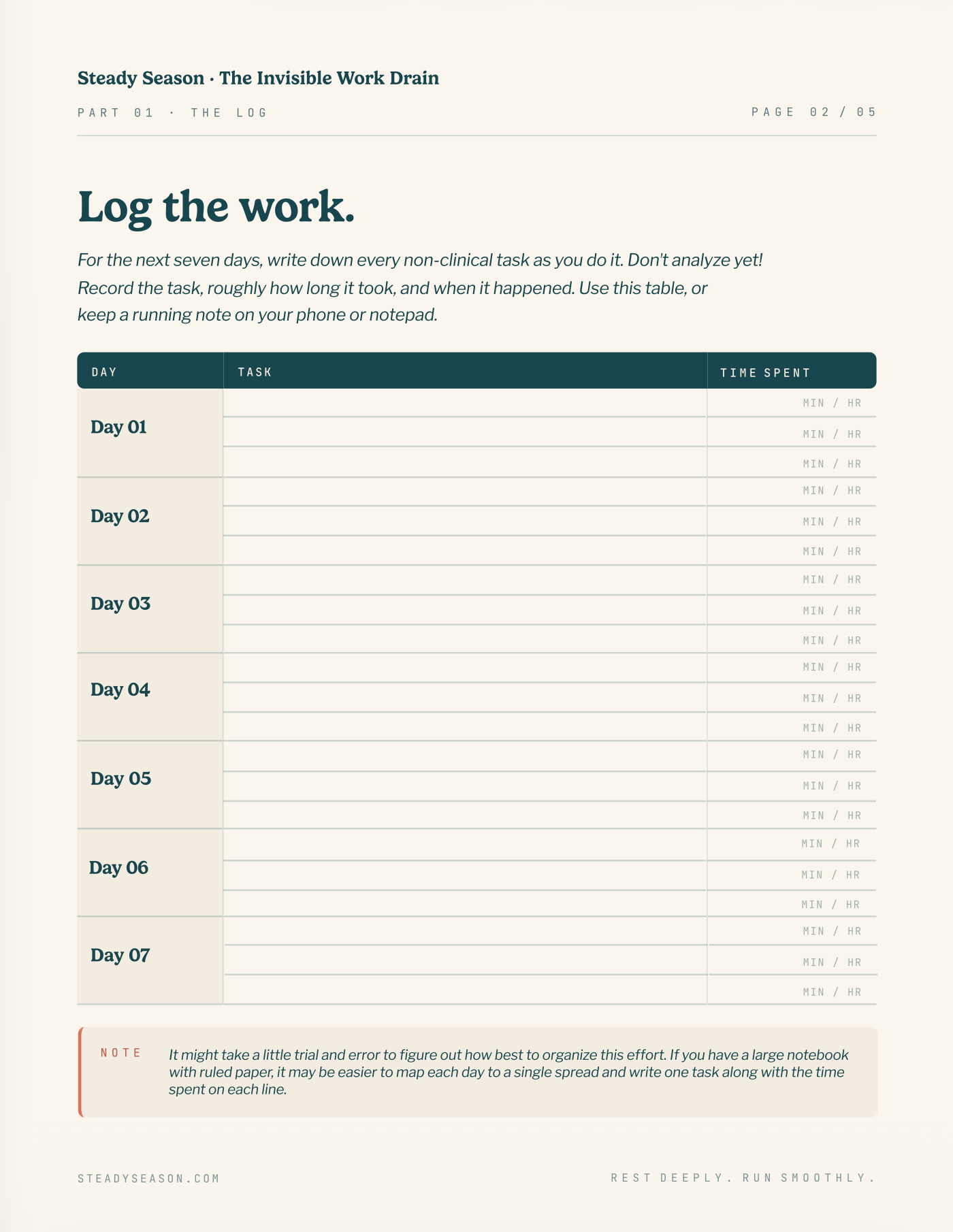
Your task for the next 7 days: write down every non-clinical task as you do it.
You’re not analyzing yet. You’re just recording. Keep it simple: a note in your phone, a piece of paper on your desk, a running doc. Every time you do something that isn’t directly serving a client, write it down.
What to capture:
- The task (what you did)
- Roughly how long it took
- What day and time it happened
How to commit:
- Start your week by writing a sketch of what you think will happen, how you expect your non-clinical time to be distributed.
- Schedule 30 minutes at the beginning and end of each day to log what really happened.
This method provides dedicated space so you won’t forget or neglect this activity, and in the end, you get a thorough study and the ability to compare your sketch to what actually happened.
Part 2: The sort
Once you have your log, organize what you found.
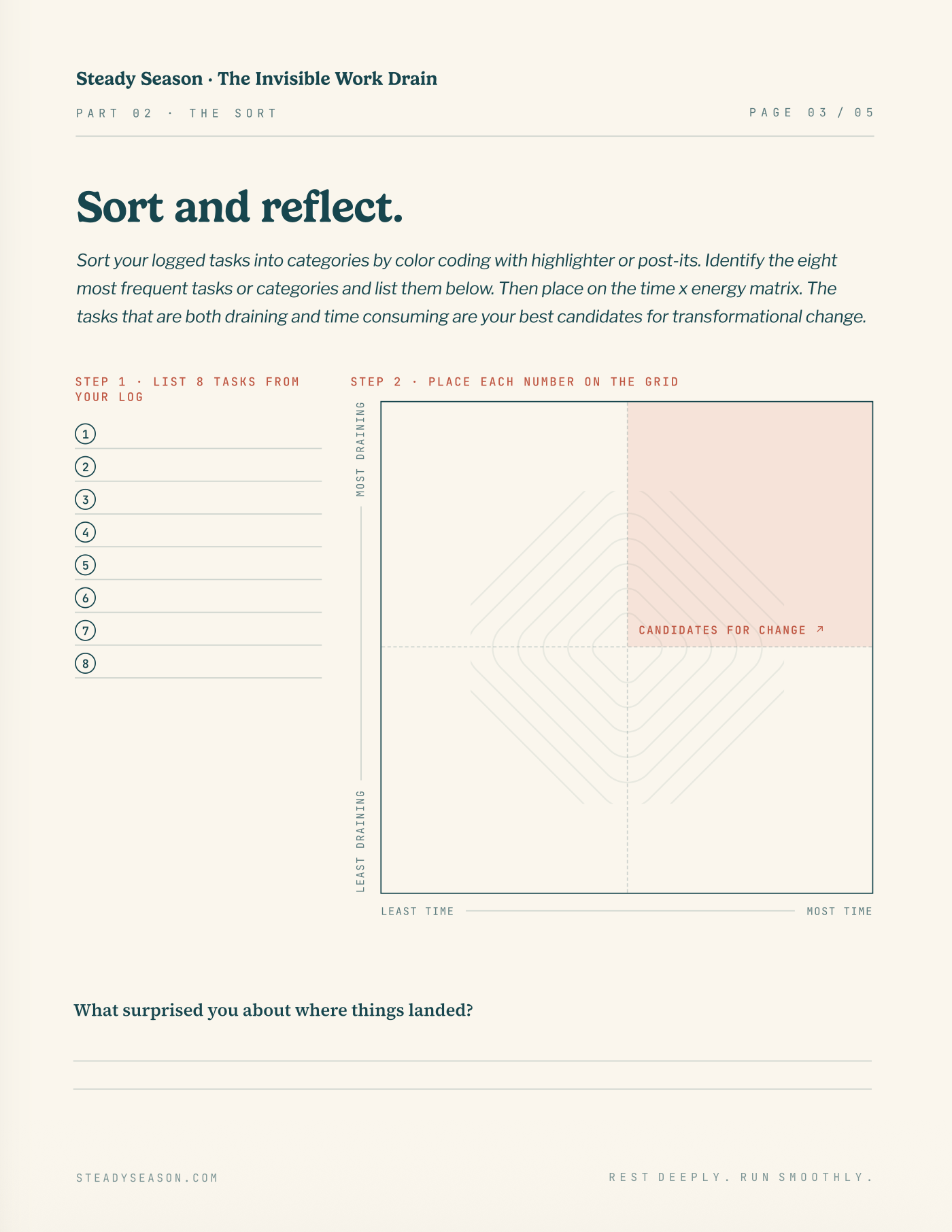
Group your tasks into categories. Use whatever system works for you. Here are some methods that have worked for me:
- Choose your categories and assign a colored highligher to each. Highlight each task with the correpsonding color. Then reflect on the visual patterns.
- Write each task on a sticky note and find a large blank wall or table where you can post them. Arrange them into categories and label each group.
The categories below are a starting point. Adjust them to fit your practice.
Suggested categories:
- Scheduling and rescheduling
- Client communication (messages, emails, follow-ups)
- Financial admin (invoicing, payment tracking, bookkeeping)
- Content and marketing (emails, social, events)
- Operations and overhead (software, supplies, systems, troubleshooting)
- Other
Sort within each category:
Add a star or symbol to each task to help you quickly identify the more routine v irregular tasks.
- Routine (happens every week or on a regular cycle)
- Irregular (occasional, seasonal, or unpredictable)
Part 3: The energy dimension
Not all tasks are equal. Time alone doesn’t tell the full story.
Some non-clinical work drains you even if it only takes 10 minutes. Some of it is genuinely fine, or even satisfying. If a task makes you feel so low that you put it off, or you need to take an extra long break after, consider whether that task is worth changing.
This exercise is really an extension of the sort, but it can be emotionally draining in it’s own right, so we break it out seperately.
Go back to your sorted categories from Part 2. For each one, mark it:
- Draining — leaves you depleted, resentful, or avoidant
- Neutral — you do it without much feeling either way
- Energizing — you don’t mind it, or you actually like it
Then arrange your categories on a simple spectrum: most draining on one end, most energizing on the other. Post-its on a wall work well here. So does a simple list. Take a photo of whatever you make so you don’t lose it.
Look at what’s on the draining end. A 15-minute task you dread every week costs more than just 15 minutes, especially if you need to take 15 more minutes to psych yourself up to get started with it. If it’s helpful, adjust the time estimates to incorporate the anticipation and recovery time.
Now map the most frequent tasks or categories onto a time x energy matrix:
Either using a large paper, the worksheet provided, or that large table or blank wall, create a matrix:
- Horizontal axis (left to right): Least to most energy draining
- Vertical axis (bottom to top): Least to most time intensive
Now, tasks or categories that are both time intensive and energy draining will sit neatly in the upper right corner. Conveniently, these are your best candidates for change.
Part 4: The math
Time has a cost. But the math isn’t as simple as multiplying your admin hours by your session rate. Admin hours are a behind-the-scenes component of your clinic hours, and you can quantify them as such.
Start with your billable hours, the sessions you actually delivered this week. Multiply by your rate. That’s your run rate: what your practice earned.
Now add in your non-billable hours, everything you logged in Part 1. That’s your total working time.
The formula:
Weekly earnings ÷ total hours worked (billable + non-billable) = your effective hourly rate
Example: You saw 20 clients this week at $150/session. That’s $3,000. But between scheduling, invoicing, emails, and everything else, you worked 30 hours total. Your effective rate is $100/hour.
That gap between your session rate and your effective rate is the real cost of overhead. In other words, it represents what your time is actually worth right now, given how you’re spending it.
And here’s where the math gets interesting: if you cut 5 hours of admin without changing anything else, your effective rate jumps to $120/hour. You earned the same amount in less time, which means either money back in your life or open slots you could fill. If you fill even two of those reclaimed hours with clients, your weekly earnings go up by $300 and your effective rate climbs to $132.
Whether you’re interested in freeing up time, or adding more billable hours and boosting revenue, this equation quantifies the admin problem in a way that can unlock new ideas and reframe old challenges.
I started working with a practitioner recently because her admin was too costly. Every invoice, every follow-up, every piece of scheduling was done by hand. When we ran these numbers together, the gap between her session rate and her effective rate sparked a productive conversation. She didn't just want fewer admin hours. She wanted more time with her family, and she wanted room to eventually expand into new modalities. The math showed her both were possible, with changes she could start making now.
Reflection
Take a short break after completing Parts 1 through 4. Come back with fresh eyes. Then sit with these questions.
What are your top 3 time and energy drains?
What would you most like to change?
What’s going well? What do you want to leave as it is?
How many hours per week would you like to reclaim? What would you do with them?
What does it look like when your billable and non-billable hours feel harmonious? What would it take to get there?
From audit to action
You now have three things: a clear picture of where your time goes, a number that represents the cost of your current overhead, and a short list of what you’d most like to change.
The next question is what to do about it. Some drains are worth addressing with a better system. Some are worth bringing in help for. Some are good candidates for AI tools — especially tasks that are repetitive, time-consuming, and don’t require your clinical judgment or expertise.
Extra credit: the investment frame
If you’re ready to think about making a change, here’s a useful way to size it.
Take the gap from Part 3 — the difference between your session rate and your effective rate — and multiply it by your total hours worked, then by 50 weeks. That’s the annual value of your current overhead. If you reclaim even a portion of that time:
- If those hours go back to client work, calculate what you’d earn at your current rate.
- If those hours go back to your life — more time with family, less childcare, cooking instead of ordering in — estimate what that’s worth in concrete terms.
An investment worth 10–20% of that annual figure is a reasonable budget for making a change and still coming out significantly ahead.
Your investment frame:
Annual value of reclaimed time: $___
Reasonable investment range (10–20%): $___
Whatever you found here, talk about it with a peer, a colleague, or someone who knows this kind of work. The audit is useful on its own. It’s more useful when you think it through with someone else.